

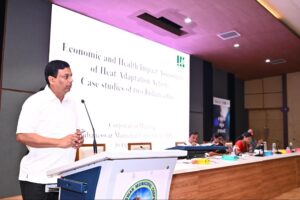
Professor Purnamita Dasgupta, Chair Professor and Head of the Environmental and Resource Economics Unit at the Institute of Economic Growth, Delhi, delivered a keynote address on the assessment of heat-health risks and economic impacts at a national symposium organised by the Indian Meteorological Society Pune, Indian Institute of Tropical Meteorology, and India Meteorological Department.
Professor Dasgupta highlighted the growing concern of heat stress in India, emphasising the need for effective interventions to protect vulnerable populations. The presentation delved into the various pathways of health risks associated with heat stress and the potential economic and social consequences, particularly for the elderly, children, and outdoor workers.
The address also discussed the range of adaptation interventions to manage heat-health risks, including the evaluation of economic costs and the assessment of benefits from effective interventions. By prioritising cost-effective solutions and addressing the challenges of implementation, India can mitigate the adverse impacts of heat stress and build resilience to climate change.
Related Post
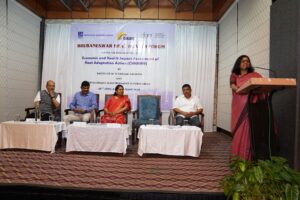
Bhubaneswar Municipal Corporation Prioritises Heat Adaptation with Support for Project CHHANW
On October 30, 2024, Bhubaneswar Municipal Corporation (BMC), a primary stakeholder of the study project, hosted a high-level stakeholder presentation in the Corporation meeting for the project “Economic and Health Impact Assessment of the Heat Adaptation Action- Case Studies from India” led by the Institute of Economic Growth (IEG), based on an earlier presentation for […]

Purnamita Dasgupta and Girika Sharma presented a paper titled ” Climate Finance for Adaptation and Sustainable Development in India,” co-authored by both, at the 2nd Annual Conference on Public Finance and Policy held at Madras School of Economics, Chennai, with their presentation delivered virtually. The conference was held on March 7 and 8, 2024.
The paper presented an overview of climate finance, with a special focus on flows of finance for adaptation. A desk analysis of available studies and estimates on finance needs and flows from developed to developing countries, and the current scenario in terms of flows from various international and domestic sources was conducted. The findings established the lack of uniformity and incomparability across methods used to estimate finance needs and the insufficiency of current financial flows for enabling the required transition to a climate-resilient economy for India. Prioritisation of resource allocations that integrated adaptation with developmental outcomes could lead to a transition that was compatible with sustainable development. Subsequently, an empirical comparative analysis of adaptation expenditures and needs linked to the consequences of climatic events across states yielded some interesting insights on the relationships between these variables. Choosing health as an indicator of development, the empirical analysis established a positive relationship between disaster preparedness and achievement of good health outcomes, and between adaptation expenditures and reduction in mortality. However, across states planned budgetary allocations did not match with adaptation investment needs. The paper presented preliminary evidence on how developmental gaps correlated with fund flows and needs for adaptation. Methodological differences and lack of coordination across sectors, large gaps between needs and available fund flows in the aggregate, low budgetary flows to critical sectors such as health, and lack of flows from the private sector for adaptation were some of the most important challenges. The use of standardised frameworks to accurately assess cost-effectiveness and returns on adaptation investments could encourage private finance and remove uncertainties in the investment climate. The assessment reinforced the need for mobilisation and alignment of adaptation finance flows with developmental needs across states and sectors. Prioritisation of cross-sector actions to align sectoral budgetary allocations between key developmental and climate outcomes could be beneficial in pursuing transformation.
Related Post
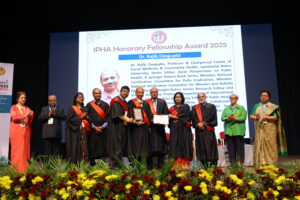
Addressing Heat-Health Risks: Chhanw Team’s Key Contributions at the 69th IPHA Conference
The 69th Annual Conference of the Indian Public Health Association was held at the Jawaharlal Nehru Medical College, KLE Academy of Higher Education and Research in Belagavi, Karnataka from 21 to 23 March 2025. The theme of the conference was Transforming Public Health in India: Innovations, Challenges, Diplomacy and Future Horizons. The Chhanw team of […]

Paper Presentation – DAAD-sponsored International Conference entitled “Climate Change: A Socio-geological Perspective” organised by The School of Liberal Arts, Indian Institute of Technology Jodhpur
Shivangi Shankar and Girika Sharma made a presentation titled “How Heat Affects HerHealth: Exploring the Impact of Increasing Temperatures on Women’s Health,” at the DAAD-sponsored International Conference entitled “Climate Change: A Socio-geological Perspective,” organised by The School of Liberal Arts, Indian Institute of Technology Jodhpur, with their presentation delivered virtually. The conference was held on […]

Paper Presentation at 23rd IASSI Annual Conference
Girika Sharma, a Senior Research Analyst at IEG, presented a paper titled “Climatic Vulnerability and Health Risks: An All-India Analysis” at the 23rd IASSI Annual Conference held at BIT Mesra, Ranchi, from October 25th to 27th, 2024. The paper, co-authored by Purnamita Dasgupta, Madhura Chowdhari, Gudakesh, William Joe, and Girika Sharma, delved into how climatic […]