

The changing weather pattern is an architectural and urban planning challenge. Building designs need to prioritise ventilation and energy efficiency, while public policy should nudge in dustry to devise cooling solutions for low-income households.
Summers in most parts of India have usually been harsh. However, sunset would bring some relief. The evening breeze and lower temperatures allowed the human body to recover from daytime stress. But this pattern is changing. Nights have become uncomfortable, especially for those without access to air conditioning. A recent study by Climate Trends, a Delhi-based climate research organisation, in medium- and low-income residential units in Chennai, showed that the peak night temperature was not very different from that experienced by people during the hottest part of the day. Research on the ways this changing weather pattern is affecting people’s lives is an emerging field. Heat-related morbidity is also under-reported and not properly documented. But studies have underlined how heat can cause cardiac stress and worsen existing illnesses, including respiratory problems and kidney ailments. The elderly, children and people dependent on outdoor jobs — vendors, construction workers, and those employed in the gig economy — are particularly vulnerable.
Several Indian states, cities and even districts have heat action plans (HAPs). They generally include early-warning systems, public advisories, cooling centres and coordination between local agencies. However, the quality of these plans is uneven. Several lack dedicated funding and enforcement mechanisms. The emphasis is overwhelmingly on emergency response, and inadequate attention is given to long-term adaptation. Most of them fail to identify the most vulnerable sections and do not suggest roadmaps to incorporate heat resilience in urban governance. A White Paper by researchers at Harvard University’s Salata Institute, released in April, underlines the scale of the challenge — it pointed out that close to 38 crore workers in India are exposed to heat, but the country’s adaptation policies are deeply unequal.
In most of urban India, natural landscapes have been replaced with heat-absorbing concrete, asphalt and glass. The arrangement of housing enclaves has shrunk air corridors. The changing weather pattern, therefore, is also an architectural and urban planning challenge. Building designs need to prioritise ventilation and energy efficiency, while public policy should nudge industry to devise cooling solutions for low-income households. The country cannot postpone meaningful conversations on improving living conditions in the face of climate vagaries.
Related Post

Heat has health consequences, and economic ones too
The Government of India has consistently reiterated its global climate commitments. As the world heats up, heat health is increasingly occupying centre stage during the summer months. The Global Heat Health Information Network cautions that heat is a serious human health concern and that the number of people exposed to extreme heat is growing exponentially due to climate change […]
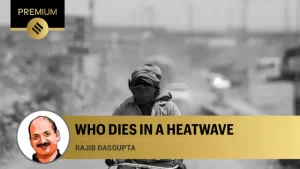
Who dies in a heat wave? High temperatures don’t affect everyone equally
In theory, heat-related deaths and illnesses are preventable, albeit with specific policies and interventions. The individuals who died in Noida included a ragpicker, a manual labourer and a security guard — and they were migrants Heat is both an environmental and occupational health hazard. The National Programme on Climate Change and Human Health (NPCC-HH) under […]

Tracking ‘heat health’ in summer of heat wave
India needs to adopt a decentralised model to deal with extreme events, drawing on planning and communitisation models enshrined in the National Health Mission The political heat that the ongoing Lok Sabha polls have generated aside, the effect of the impending weeks of summer on the campaign and the actual polling process is part of […]

The long night of India’s heatwave
From poor sleep to higher mortality chances, rising nighttime heat is reshaping the country’s climate emergency. Heat waves occur in India from March to June or July, and warnings are typically based only on the maximum surface air temperature (daytime). Daytime-only heatwaves (DHW) are increasingly turning into nighttime-only (NHW) and day-night compound heatwaves (CHW), and […]