
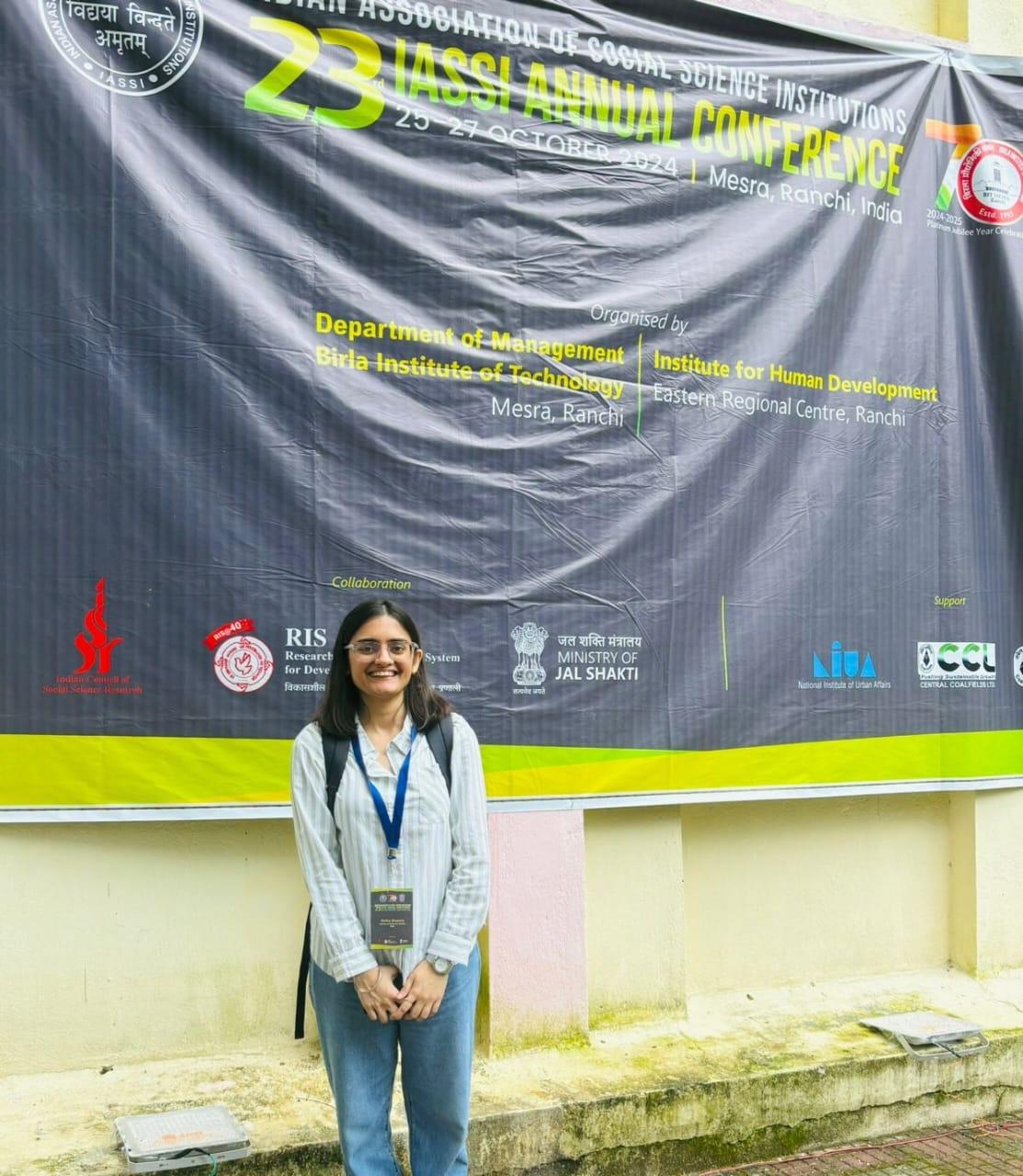
Girika Sharma, a Senior Research Analyst at IEG, presented a paper titled “Climatic Vulnerability and Health Risks: An All-India Analysis” at the 23rd IASSI Annual Conference held at BIT Mesra, Ranchi, from October 25th to 27th, 2024.
The paper, co-authored by Purnamita Dasgupta, Madhura Chowdhari, Gudakesh, William Joe, and Girika Sharma, delved into how climatic vulnerability influences health risks and wellbeing across India. The study focuses on Sustainable Development Goal (SDG) 3—Good Health and Wellbeing and SDG 2- Zero Hunger, and investigates the challenges posed by climate vulnerability to achieving SDG targets related to health.
Using nationally representative datasets, A district-level econometric analysis (575 districts) is done using climate vulnerability data (CRIDA, 2019) and health data from NFHS-5. By examining the relationship between climate vulnerability and health indicators, the study seeks to shed light on how vulnerability to climate change correlates with health disparities,thus informing targeted health interventions and policy decisions tailored to regions most atrisk. high-vulnerability districts consistently underperform in all SDG health outcomescompared to low-vulnerability districts. Notably, these results remain robust even whencontrolling for other identifiable factors. This emphasises the necessity of accounting forclimatic vulnerability when assessing SDG health indicators, as it plays a critical role indetermining the overall effectiveness of health-related development efforts.
The Conference provided valuable insights into the pressing issues of climate change, sustainable development, and inclusive growth. The sessions on governance, climate change, technological transformation, and social protection also highlighted key challenges and strategies for India’s development.
Related Post

Paper Presentation – DAAD-sponsored International Conference entitled “Climate Change: A Socio-geological Perspective” organised by The School of Liberal Arts, Indian Institute of Technology Jodhpur
Shivangi Shankar and Girika Sharma made a presentation titled “How Heat Affects HerHealth: Exploring the Impact of Increasing Temperatures on Women’s Health,” at the DAAD-sponsored International Conference entitled “Climate Change: A Socio-geological Perspective,” organised by The School of Liberal Arts, Indian Institute of Technology Jodhpur, with their presentation delivered virtually. The conference was held on […]
Addressing Heat-Health Risks: Chhanw Team’s Key Contributions at the 69th IPHA Conference
The 69th Annual Conference of the Indian Public Health Association was held at the Jawaharlal Nehru Medical College, KLE Academy of Higher Education and Research in Belagavi, Karnataka from 21 to 23 March 2025. The theme of the conference was Transforming Public Health in India: Innovations, Challenges, Diplomacy and Future Horizons. The Chhanw team of […]
Paper Presentation – Second Annual Conference on Public Finance and Policy at Madras School of Economics, Chennai
Purnamita Dasgupta and Girika Sharma presented a paper titled ” Climate Finance for Adaptation and Sustainable Development in India,” co-authored by both, at the 2nd Annual Conference on Public Finance and Policy held at Madras School of Economics, Chennai, with their presentation delivered virtually. The conference was held on March 7 and 8, 2024. The […]